
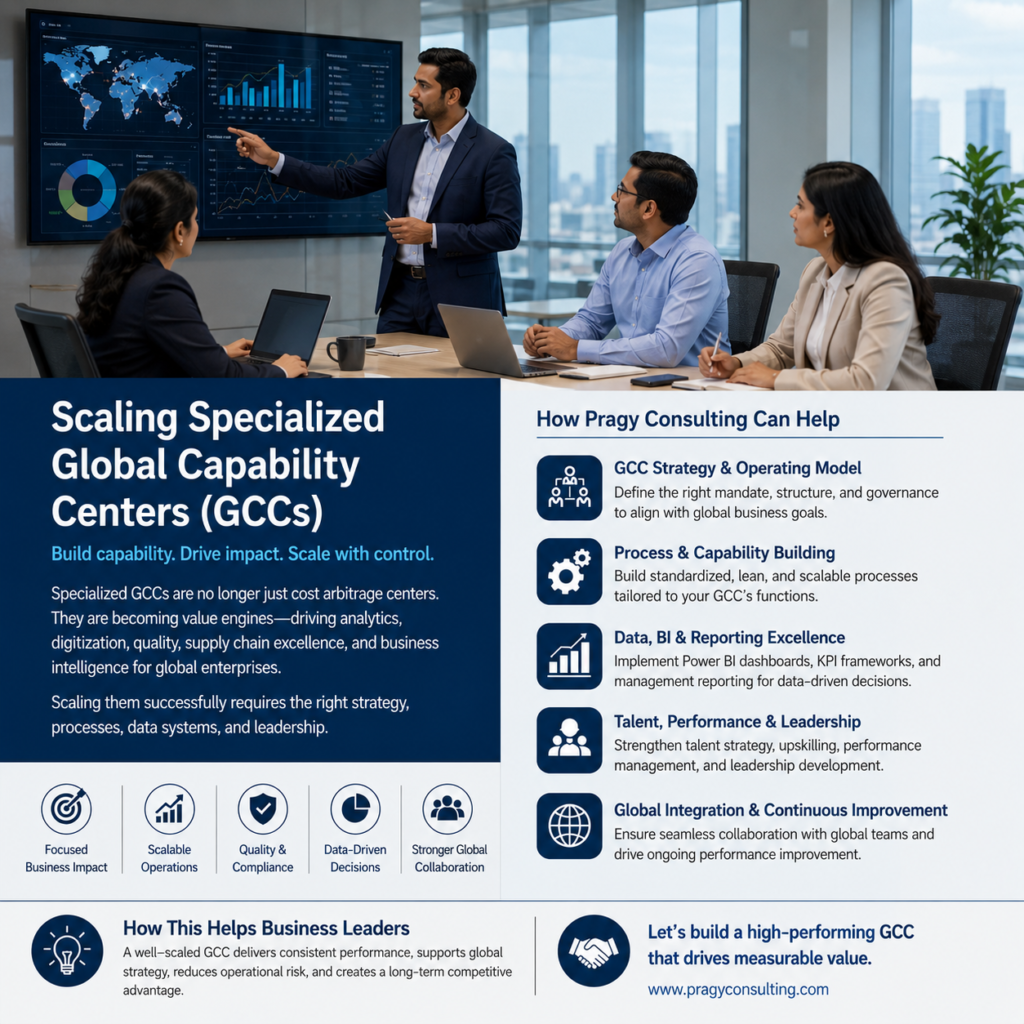
Specialized Global Capability Centers, or GCCs, are no longer viewed only as offshore delivery extensions. Many organizations now expect their GCCs to support enterprise capability, analytics, digital transformation, process excellence, and function-specific expertise across regions.
For business leaders, the challenge is not simply how to grow a GCC. The real question is how to scale it with the right mandate, governance, data systems, process discipline, and measurable business outcomes.
A specialized GCC may focus on finance analytics, supply chain planning, quality operations, manufacturing analytics, pharmacovigilance support, regulatory operations, commercial analytics, procurement, HR operations, or enterprise reporting. Each specialization requires different skills, processes, controls, and performance measures. Scaling these centers successfully means building a strong operating system, not just increasing headcount.
What Makes a GCC Specialized?
A traditional shared services model often focuses on transactional efficiency. A specialized GCC goes further. It builds deep capability in a business function or technical domain and becomes a structured extension of global operations.
For example, a pharma operations GCC may support quality metrics, batch release reporting, deviation trend analysis, regulatory data preparation, and manufacturing performance dashboards. A manufacturing analytics GCC may focus on OEE reporting, downtime analysis, production planning, maintenance performance, yield tracking, and cost visibility. A finance GCC may support margin analysis, budget tracking, management reporting, and business performance reviews.
The value of specialization comes from repeatable expertise. The risk comes when growth happens faster than governance, process maturity, and data quality. Without a clear scaling model, the GCC can become busy but not necessarily effective.
Scaling Specialized GCCs Requires More Than Headcount
Adding people can increase capacity, but it does not automatically improve business impact. In many cases, rapid growth creates more complexity. Teams may duplicate reports, use different KPI definitions, rely on manual spreadsheets, or create local workarounds that are difficult to control.
A scalable GCC needs a deliberate foundation:
- Clear mandate: What business outcomes should the GCC support?
- Defined service catalogue: What services will the center provide, and what is out of scope?
- Process ownership: Who owns standardization, escalation, and improvement?
- KPI framework: How will performance, quality, timeliness, and value be measured?
- Governance cadence: How will global stakeholders review priorities, risks, and benefits?
- Technology stack: Which systems, dashboards, and automation tools will enable scale?
When these elements are missing, leaders may see activity but struggle to see value. Reports are produced, meetings are held, and resources are added, but decision-making may still be slow and fragmented.
Start With the GCC Mandate and Value Proposition
Before scaling, leaders should define the purpose of the GCC in practical business terms. A weak mandate says, “support global reporting.” A stronger mandate says, “deliver standardized, trusted, and timely performance visibility for global manufacturing, quality, supply chain, and finance leaders.”
The mandate should answer four questions:
- Which business functions will the GCC support?
- Which decisions should the GCC help improve?
- Which processes should become more standardized or efficient?
- Which KPIs will show whether the GCC is creating value?
This is especially important for pharma, manufacturing, supply chain, and finance functions where process control, compliance awareness, and data reliability matter. A specialized GCC cannot operate effectively if each region defines metrics differently or if business users do not trust the reporting outputs.
Build a KPI and Dashboard System Early
Power BI dashboards and business intelligence systems are critical for scaling specialized GCCs. They provide a common view of performance, reduce dependency on manual reporting, and help leaders focus on exceptions instead of searching for information.
A strong GCC dashboard environment should include:
- standard KPI definitions and calculation logic;
- role-based dashboards for executives, managers, and process owners;
- data refresh schedules aligned with business review cycles;
- clear ownership for data quality and issue resolution;
- trend views, drill-downs, and exception reporting;
- links between operational metrics and business outcomes.
For example, a supply chain GCC may track forecast accuracy, service levels, inventory ageing, supplier performance, and S&OP action closure. A manufacturing GCC may track OEE, downtime, production adherence, yield loss, quality deviations, and maintenance backlog. A finance GCC may track working capital, margin movement, budget variance, invoice cycle time, and reporting turnaround.
Dashboards should not become decorative reports. They should support regular management routines, root cause analysis, escalation, and improvement actions.
Use Lean Six Sigma to Standardize and Improve GCC Processes
As GCCs scale, process variation becomes one of the biggest barriers to consistent performance. Teams may support multiple countries, plants, business units, or product lines. Without standard work, the same service may be delivered in different ways by different teams.
Lean Six Sigma methods help GCCs create consistency and reduce waste. Practical tools include SIPOC maps, process flowcharts, RACI matrices, value stream mapping, root cause analysis, control plans, and visual management routines.
For specialized GCCs, Lean Six Sigma should not be treated as a separate improvement program. It should be embedded into daily operations. Teams should regularly review defects, rework, delays, handoff issues, and recurring escalations. Improvement opportunities should be prioritized based on business impact, risk, and effort.
Design Governance That Connects the GCC to Global Business Priorities
A GCC can only scale effectively when governance connects delivery teams with business stakeholders. This means more than monthly status meetings. Leaders need a structured cadence for performance, demand management, prioritization, risk review, and improvement tracking.
A practical governance structure may include:
- Operational reviews: Weekly or biweekly reviews of service performance, backlog, quality issues, and escalations.
- Functional reviews: Monthly reviews with finance, supply chain, quality, manufacturing, or commercial stakeholders.
- Leadership reviews: Quarterly reviews focused on value, capability roadmap, risks, and strategic priorities.
- Improvement reviews: Regular reviews of Lean Six Sigma projects, automation opportunities, and dashboard enhancements.
Good governance prevents the GCC from becoming a request-processing center. It helps the center become a structured capability partner for the business.
Develop Specialized Talent and Career Paths
Specialized GCCs need talent that understands both business processes and data. A Power BI developer who understands manufacturing operations can build more useful dashboards than one who only understands visualization. A process analyst who understands quality systems can identify better improvement opportunities than one who only tracks task completion.
Leaders should define capability paths for roles such as business analyst, dashboard developer, process improvement lead, data steward, functional SME, automation analyst, and service delivery manager. Training should include business process knowledge, analytics, data quality, stakeholder management, documentation, and continuous improvement.
This is also where performance management matters. Teams should not be measured only on volume. They should also be measured on accuracy, timeliness, stakeholder satisfaction, improvement contribution, and the usefulness of insights delivered.
How This Helps Business Leaders
A well-scaled specialized GCC gives business leaders better visibility, stronger control, and faster access to operational insights. Instead of relying on disconnected spreadsheets and manual updates, leaders can use standard dashboards and structured review routines to understand performance across functions, locations, and time periods.
For pharma and manufacturing leaders, this can support better quality reviews, production performance management, deviation trend monitoring, inventory visibility, and S&OP discussions. For finance and business leaders, it can improve management reporting, cost analysis, working capital visibility, and decision support.
The main benefit is not reporting volume. The benefit is better decision discipline. Leaders can spend less time debating data and more time acting on issues, risks, and opportunities.
Common Scaling Risks to Avoid
Several issues can weaken a specialized GCC as it grows:
- scaling teams before defining the operating model;
- creating too many dashboards without KPI governance;
- accepting inconsistent data definitions across regions;
- measuring activity instead of value;
- separating process improvement from daily delivery;
- underinvesting in stakeholder management and business context;
- treating Power BI as a reporting tool instead of a decision-support system.
These risks are manageable when leaders build the GCC around clear processes, strong governance, data ownership, and continuous improvement.
How Pragy Consulting Can Help
Pragy Business Process Consulting Services helps organizations strengthen GCC performance through practical operating models, KPI systems, Power BI dashboards, Lean Six Sigma support, and process improvement methods.
Support can include:
- defining GCC performance metrics and management reporting structures;
- designing Power BI dashboards for operations, finance, supply chain, manufacturing, quality, and S&OP;
- standardizing KPI definitions and dashboard governance;
- mapping and improving GCC service delivery processes;
- supporting Lean Six Sigma initiatives for process efficiency and control;
- creating leadership reporting packs and review routines;
- building practical continuous improvement roadmaps.
Scaling a specialized GCC is not only a location or staffing decision. It is an operating model decision. With the right dashboards, process discipline, governance, and improvement systems, GCCs can become reliable capability partners for global business leaders.
If your organization is building or scaling a specialized GCC, Pragy Business Process Consulting Services can help you create the KPI structure, dashboard visibility, and process improvement foundation needed to scale with control and clarity.