
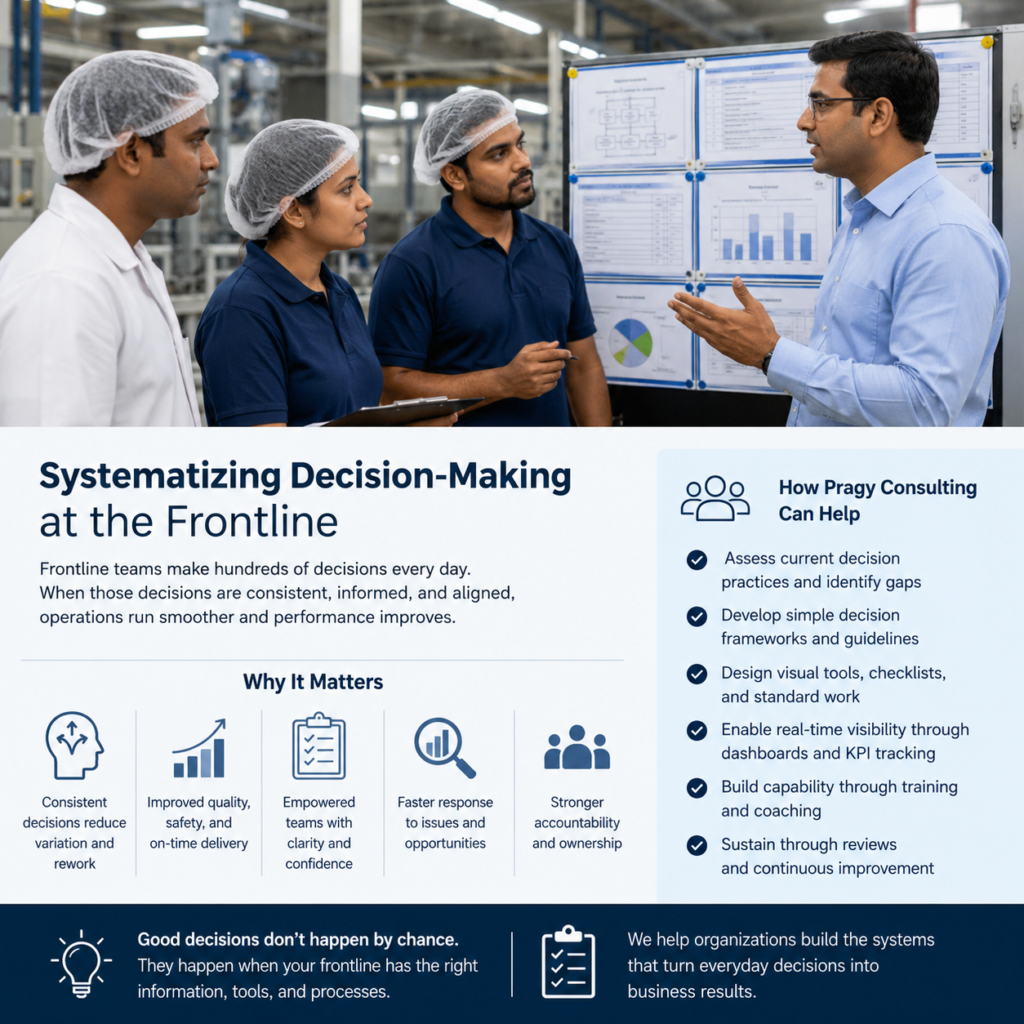
Frontline decision-making has a direct impact on operational performance. Supervisors, team leads, operators, planners, quality teams, and maintenance teams make practical decisions every shift: what to prioritize, when to escalate, how to respond to a deviation, whether to stop a process, how to allocate resources, and how to communicate risks.
When these decisions depend only on individual experience, performance can vary from shift to shift. One supervisor may escalate early, while another may wait. One team may track issues clearly, while another may rely on verbal updates. One production area may understand the daily priorities, while another may work from incomplete information.
Systematizing decision-making at the frontline means giving teams a clear, repeatable way to make decisions using defined rules, relevant data, standard work, and practical escalation paths. It does not remove judgment. It improves the quality and consistency of judgment.
Why Frontline Decision-Making Needs a System
Many operational problems do not begin as major failures. They often start as small delays, unclear ownership, missed handoffs, slow escalations, or inconsistent interpretations of the same information. These issues are common in manufacturing, pharma operations, quality, supply chain, finance operations, and service businesses.
A structured frontline decision-making system helps teams answer basic but important questions:
- What decisions can the frontline team make independently?
- Which decisions require escalation?
- What data should be reviewed before making a decision?
- Who owns the next action?
- How quickly should an issue be addressed?
- Where should decisions and actions be recorded?
Without clarity, teams may spend too much time discussing the same recurring issues. Leaders may get involved too late or too often. Dashboards may exist, but they may not be connected to daily decision routines. A good decision system connects people, process, and data.
What a Frontline Decision System Looks Like
A practical decision-making system does not need to be complicated. It should be simple enough for daily use and strong enough to guide consistent action. The core elements usually include decision rights, escalation rules, standard work, KPI visibility, and review routines.
1. Clear Decision Rights
Frontline employees need to know which decisions they are authorized to make. For example, a production supervisor may be able to adjust staffing within a shift, but a schedule change affecting customer delivery may require planning approval. A quality technician may be able to place material on hold, but disposition may require quality leadership review.
Clear decision rights reduce hesitation and prevent unnecessary escalation. They also help leaders avoid becoming bottlenecks for routine decisions.
2. Defined Escalation Triggers
Escalation should not depend on personal preference. Teams need simple triggers that define when an issue must be raised. These triggers may relate to safety, quality, delivery, cost, compliance, downtime, inventory risk, or customer impact.
For example, a pharma operations team may escalate immediately when there is a potential GMP concern, documentation gap, or batch-impacting deviation. A manufacturing team may escalate when downtime exceeds a defined threshold, when a critical material shortage affects the schedule, or when a quality issue appears repeatedly across shifts.
3. Standard Work for Daily Decisions
Standard work helps teams follow a consistent approach. It can include daily huddle formats, shift handover checklists, deviation response steps, production priority rules, maintenance escalation paths, and issue review templates.
The goal is not to create paperwork. The goal is to make good decisions easier. When standard work is clear, frontline teams do not have to recreate the process every time a common issue occurs.
4. KPI Visibility Through Dashboards
Decision-making improves when teams can see the right information at the right time. Power BI dashboards can support frontline decision-making by providing current views of production performance, quality trends, downtime, backlog, inventory, schedule adherence, service levels, and open actions.
However, dashboards alone are not enough. A dashboard should support a decision routine. For example, a daily production dashboard should help teams decide what to prioritize, what risks to escalate, and what actions must be completed before the next review.
5. Action Tracking and Accountability
Frontline decision systems should include a simple method for recording actions, owners, due dates, and status. This may be managed through a visual board, a shared tracker, Power BI action reporting, Microsoft Lists, Excel, or another workflow tool.
The tool matters less than the discipline. Every decision that requires follow-up should have an owner. Every recurring issue should be reviewed for root cause. Every overdue action should be visible.
Examples Across Operations
In a manufacturing environment, a frontline decision system may help supervisors decide how to respond to machine downtime, labor shortages, schedule changes, quality defects, and urgent customer orders. Instead of relying on informal judgment, the team can use predefined priority rules and escalation triggers.
In pharma operations, the same concept can support batch review readiness, deviation triage, documentation checks, material status review, and production schedule risk management. The system must respect compliance expectations while helping teams act quickly and consistently.
In supply chain and S&OP environments, structured decision-making can help planners escalate shortages, capacity constraints, demand changes, and service risks before they become larger business issues. Dashboards can make these risks visible, while governance routines help leaders decide what action to take.
In finance and small business operations, frontline decision systems can improve invoice issue handling, cash collection follow-up, approval workflows, reporting exceptions, and customer service escalation. The same principles apply: define decision rights, use reliable data, clarify escalation, and track actions.
How Power BI Supports Frontline Decision-Making
Power BI can play an important role when it is designed around operational decisions rather than only management reporting. A useful dashboard should answer practical questions such as:
- What needs attention today?
- Which KPIs are outside expected limits?
- Which issues are recurring?
- Where are delays building up?
- Which actions are overdue?
- Which area, line, product, customer, or process needs support?
Good dashboard design supports action. It uses clear visuals, consistent definitions, simple filters, and meaningful drill-downs. It avoids overwhelming frontline users with too many metrics. For frontline teams, fewer well-designed KPIs are often more useful than a large report with limited decision value.
How This Helps Business Leaders
For business leaders, systematizing frontline decision-making improves operational control. Leaders gain better visibility into what is happening, where support is needed, and which issues are being resolved.
This approach also helps reduce dependency on individual workarounds. When decisions are structured, performance becomes easier to manage across shifts, teams, departments, and locations. Leaders can focus more on removing barriers, improving processes, and developing capability instead of repeatedly chasing the same issues.
A structured decision system also supports Lean Six Sigma and operational excellence efforts. It creates a stronger link between daily management, KPI reporting, root cause analysis, and continuous improvement. Problems become easier to see, prioritize, and address.
Common Mistakes to Avoid
One common mistake is creating dashboards without changing the decision process. If teams do not know how to use the dashboard in daily meetings, the report becomes another source of information rather than a tool for action.
Another mistake is overcomplicating escalation rules. Frontline teams need practical guidance, not a complex approval matrix that slows response time. The best systems are clear, visual, and easy to follow.
A third mistake is failing to review whether the system works. Decision-making routines should be improved over time. Leaders should ask whether decisions are faster, more consistent, better documented, and better aligned with business priorities.
How Pragy Consulting Can Help
Pragy Business Process Consulting Services helps organizations build practical systems for frontline decision-making, KPI reporting, dashboards, and operational improvement. The focus is on making daily decisions clearer, more data-driven, and easier to manage.
Support may include:
- Mapping current frontline decision processes and escalation gaps
- Defining decision rights, escalation triggers, and standard work
- Designing Power BI dashboards for daily operational reviews
- Improving KPI definitions, reporting structures, and action tracking
- Supporting Lean Six Sigma and process improvement initiatives
- Creating practical management routines for operations, quality, supply chain, finance, and leadership teams
Systematizing frontline decision-making is not about adding bureaucracy. It is about helping teams make better decisions with clearer information, stronger ownership, and practical routines.
If your organization needs better dashboards, clearer KPIs, or a more structured approach to operational decision-making, Pragy Business Process Consulting Services can help you design a practical system that fits your business environment.