
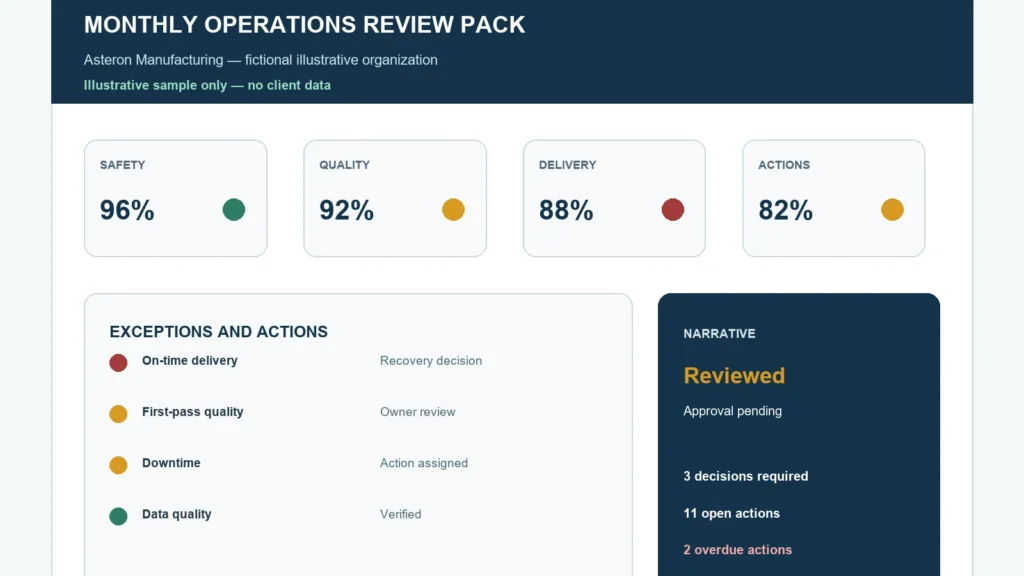
Many organizations have improved access to operational data without reducing the effort required to prepare and run a useful management review. A dashboard may refresh reliably and still leave leaders debating definitions, asking for context, deciding which exception matters, and searching for the owner of an overdue action. Visibility has improved, but the operating system around the information has not.
The Pragy AI-Enabled Operations Review System addresses that gap. It connects KPI governance, a decision-ready dashboard or scorecard, exception thresholds, review routines, decisions, actions, escalation, ownership, and optional human-reviewed AI summaries. The result is not autonomous management. It is a practical structure that helps accountable people review the right information and follow through.
Why reporting effort remains high after a dashboard launch
Reporting work often begins long before a chart appears. Teams extract information, reconcile sources, repair missing fields, explain unusual values, prepare slides, collect comments, and update action lists. If KPI definitions are weak or refresh responsibilities are unclear, every review repeats the same diagnostic work. The dashboard can make a problem visible, but it cannot decide which definition is approved or who must correct the source.
Manual narrative preparation adds another layer. Analysts may write summaries from several reports and meeting notes, while leaders adjust the wording after new context appears. Without source traceability and approval, a polished narrative can hide inconsistent assumptions. The aim should be to reduce avoidable preparation while preserving verification and accountable judgment.
Visibility is not the same as management
A dashboard displays measures, trends, and filters. Those capabilities are valuable. An operations review system defines what the measures mean, which decisions they support, who owns results and data, what creates an exception, when the review occurs, and how actions are assigned and closed. Power BI or another approved reporting layer can sit inside that broader design without being treated as the whole solution.
The central distinction is practical: observation ends with “what happened?” Management continues through “what requires a decision, who owns the response, when is it due, what evidence closes it, and what do we change before the next review?”
KPI definitions and ownership come first
A useful KPI needs more than a name. Its dictionary should state the purpose, business question, formula, unit, direction, grain, scope, inclusion and exclusion rules, result owner, data steward, source, refresh timing, target, thresholds, required response, limitations, version, and approval date. These details prevent a familiar label from masking different calculations or decision expectations.
Ownership is deliberately split where appropriate. A business owner is accountable for the result and response. A data steward is accountable for source and quality responsibilities. The review sponsor defines the decisions and escalation rights. The system owner maintains the reporting and operating routine. Clear roles reduce the temptation to treat every issue as a technical dashboard problem.
Thresholds turn measures into review signals
A red, amber, or green status should reflect approved logic rather than decoration. Thresholds need context: the direction of better performance, operating target, exception duration, volume, materiality, known data limitations, and expected action. A single unusual point may need monitoring, while a sustained condition may require escalation.
Data quality is also part of the signal. A measure should not quietly appear healthy when the refresh failed or required records are incomplete. The review view can show the last refresh, reconciliation status, known limitation, and accountable data contact so leaders understand what can and cannot be concluded.
Decisions and actions are first-class records
Meetings dominated by status reporting leave little time for decision. A stronger agenda begins with purpose, changes, data quality, and decisions required. It then focuses on critical exceptions, risks, escalations, actions, owners, and commitments. The review is designed around operating choices, not around presenting every available page.
Actions require a clear description, owner, due date, priority, status, blocker, evidence, escalation route, and closure criteria. Decisions require the issue, accountable decision maker, date, rationale or context, and resulting actions. Recording these elements makes follow-through visible without transferring accountability to the reporting team or an external advisor.
The action-closure problem
An open-action count can become another passive metric. The system must distinguish newly assigned work, on-time progress, overdue items, blocked items, escalated items, and closure awaiting evidence. The review should ask whether the underlying risk has been addressed, not only whether a row was marked complete.
Closure evidence depends on the work. It might be an approved decision, a verified process change, a completed test, or confirmation from an accountable owner. The system does not replace root-cause investigation. It provides a visible route from signal to response and from response to verified closure.
Where AI-assisted summaries can help
Where the client environment and governance allow, AI may prepare a first draft from approved metrics, exception notes, and action information. It can organize recurring context, identify items requiring verification, or structure a review narrative. This can reduce repetitive preparation when the source and review process are controlled.
AI is optional. A standard template, deterministic rule, or analyst-prepared summary may be more reliable. The Operations Review System must remain useful and auditable when AI is turned off, and the design can conclude that AI should not be used.
Why every AI draft requires human approval
An AI-assisted narrative is labelled as a draft. The reviewer reconciles every stated metric to the approved source, checks time periods and units, verifies exception context, removes unsupported claims, checks sensitive-data handling, and confirms action status. Human edits and the approval timestamp are retained before distribution.
The design also needs a controlled prompt or logic version, source traceability, error route, retention rules, and manual fallback. If a model is unavailable or the draft is unreliable, the review continues through the approved non-AI process. Accountable leaders retain every final decision.
Blueprint, Build, and Managed Review Support
The Performance Review Blueprint defines the decision model, KPI framework, data readiness, dashboard requirements, review charter, action process, optional AI feasibility, and implementation roadmap. It is appropriate when the organization needs design clarity before committing to a technical build.
The Operations Review System Build creates and pilots one bounded review system with up to twelve final KPIs and three standard data sources in the standard scope. It includes testing, training, handover, and a 45-day stabilization review. Final scope depends on data, connectors, security, licensing, refresh, users, validation, and deployment conditions.
Managed Review Support is inquiry-only support after an approved implementation or readiness review. It can help with KPI-health checks, review-pack preparation, action follow-through, facilitation support, and a controlled improvement backlog. Pragy Consulting does not make client decisions or certify metric accuracy. No subscription checkout or recurring billing is active.
Relationship to the Opportunity Map and Workflow Sprint
The AI Operations Opportunity Map helps compare possible priorities and readiness. The Workflow Intelligence Sprint can redesign and pilot one high-friction workflow. The Operations Review System can then establish the measures, review, exceptions, decisions, and follow-through required to sustain the operating result.
Organizations may enter at the stage that matches their readiness. A team with a defined review purpose, approved metric owners, and usable data may begin directly with the Blueprint or Build. A team with unstable underlying work may need the Workflow Sprint first.
Who the system is for
The system is for operational and functional leaders who can define the business area, review purpose, accountable sponsor, system owner, candidate KPIs, data sources, decisions, and action path. It can support manufacturing, quality, supply chain, finance operations, PMO, shared services, customer operations, or a focused small and mid-sized business leadership review.
It is not a dashboard-only engagement, data warehouse implementation, autonomous management system, compliance certification, or guaranteed performance program. Multi-site, regulated, sensitive-data, complex security, extensive integration, and enterprise semantic-model requirements receive custom scope.
Move from reporting to an operating rhythm
Start with the decisions the review must support. Define fewer, clearer measures. Make data condition and exceptions visible. Structure the agenda around decisions. Assign actions with owners and closure evidence. Use AI only when it adds controlled value, and keep human verification and approval explicit.