
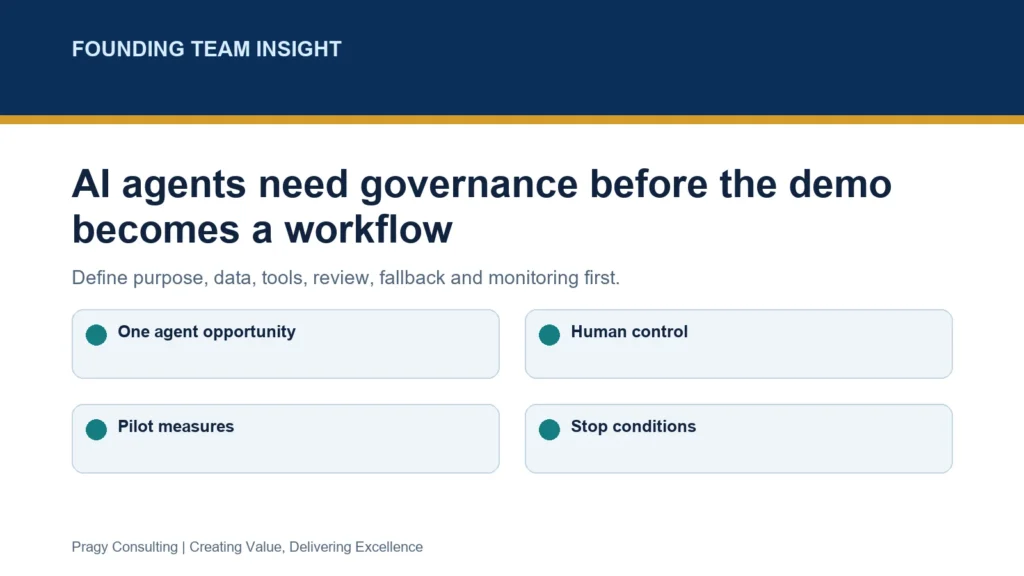
AI agents are becoming easier to demonstrate than to operate. A prototype can retrieve information, draft a response, summarize a record, call a tool or prepare a next action in a way that looks persuasive. The harder question is whether that behavior is ready to become part of a real operating workflow.
The Pragy AI Agent Readiness & Governance Accelerator exists for that gap. It helps organizations slow the decision down just enough to define what one candidate agent is for, what it may access, what it may do, when it must stop, who reviews the work and how the pilot will be monitored.
An agent is an operating role
When a system can retrieve information, reason across context and take or prepare actions, it starts to resemble an operating role. That does not mean it should receive broad authority. It means the organization needs a clear role description: trigger, purpose, users, approved sources, allowed tools, prohibited actions, exception handling, evidence, fallback and owner.
Without that definition, a team may accidentally hand a tool more operational authority than anyone intended. A helpful assistant becomes a workflow dependency. A draft becomes a recommendation. A recommendation becomes an assumed decision. The accelerator keeps those distinctions visible before build pressure takes over.
Readiness starts with the process
Many agent ideas begin with technology. The safer starting point is the work. What event starts the flow? Who owns the outcome? What information is trusted? What decision or preparation step needs help? What error would matter? What happens when the agent is unavailable or wrong?
If the process is unstable, data is unclear or ownership is missing, an agent may only make confusion faster. The right answer may be a conventional workflow, a dashboard, a rules-based automation, a better form, a human review queue or a decision to wait. “Do not use an agent yet” must remain an acceptable conclusion.
Data and tool boundaries need plain language
Agent governance is not only a technical permission model. It is an operating agreement. Teams need to know which sources are approved, what information must not be entered, whether retrieval is allowed, whether the agent can write to a system, whether it can create a task, whether it can notify a person and who verifies the result.
Those boundaries are especially important when personal data, regulated records, quality information, HR topics, financial information, customer commitments or confidential production details may be involved. The accelerator does not provide legal, privacy, cybersecurity, HR, quality, regulatory or validation advice. It identifies when those reviews are needed before an agent pilot proceeds.
Human review has to be designed
“Human in the loop” is not a control unless the loop is real. The reviewer needs source access, time, authority, criteria, escalation rights and a recorded way to accept, edit, reject or override an output. A review step also needs a fallback when the output is unsupported, incomplete, too confident, inconsistent with a source or outside the approved scope.
The standard accelerator does not approve autonomous final decisions. It defines how accountable people remain responsible for approvals, escalations, exceptions and business decisions. That includes making the agent’s limitations visible to users instead of hiding them behind a polished interface.
Testing should include refusal and fallback
Agent testing cannot be limited to happy paths. A useful pilot test asks what happens when a required field is missing, a source disagrees with another source, a request is outside scope, a user asks for an unauthorized action, confidence is low or a specialist-review trigger appears.
Acceptance criteria should include correct refusals, routing, escalation, logs, evidence, manual fallback and the ability to pause the pilot. These controls do not make the work bureaucratic; they make it operable.
The same discipline applies to tool use. If an agent can create a task, update a list, draft an email, query a system or prepare a workflow action, the test plan should prove that the action is allowed, traceable, reversible where practical and reviewed before it affects an accountable business outcome. A pilot should also show what users see when the agent reaches a boundary and how the work continues without the agent.
Measures make the pilot honest
A candidate agent should have success measures and guardrail measures before it launches. Success may involve completeness, response preparation time, exception visibility, reviewer effort or action closure. Guardrails may include override rate, unsupported output, source mismatch, fallback use, escalation volume, user feedback and unresolved exceptions.
No specific improvement should be promised before the baseline, data, user behavior, controls and technical constraints are understood. The purpose of measurement is to decide whether to scale, stabilize, redesign, pause or stop.
Where the accelerator fits
Some organizations should begin with the AI Operations Opportunity Map to compare priorities. Others may need the Responsible AI Starter Kit to establish baseline governance. If the underlying workflow itself is unclear, the Workflow Intelligence Sprint may be the better next step. If the agent supports performance review or reporting, the AI-Enabled Operations Review System may provide the operating rhythm. Quality-critical or regulated uses may require the Quality & CAPA Intelligence Accelerator or custom specialist scope.
The common thread is discipline. AI agents can be useful, but only when their role, data, tools, review, fallback and monitoring are defined clearly enough for people to operate with confidence.
Explore the Pragy AI Agent Readiness & Governance Accelerator