
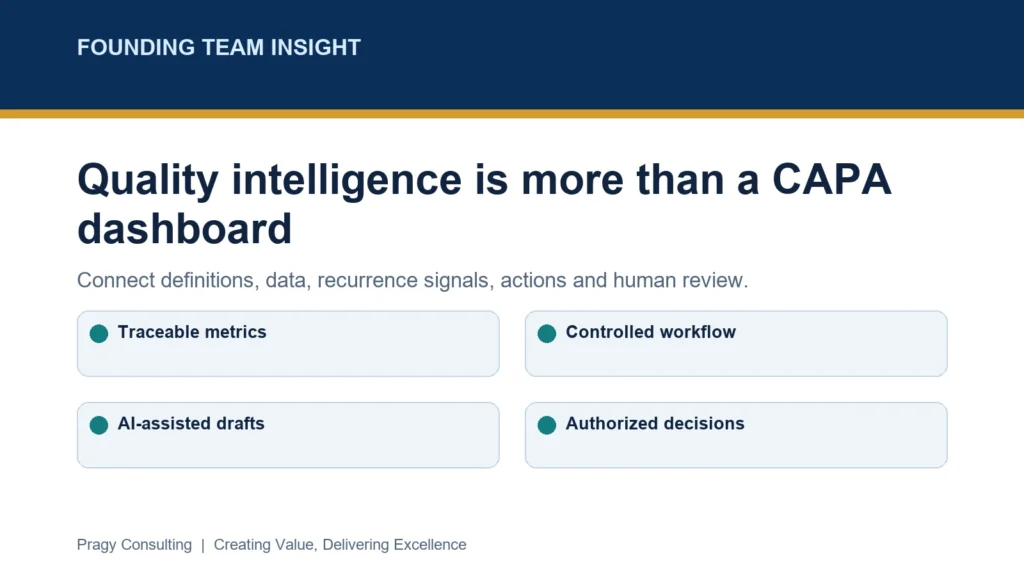
Quality organizations often have more records than usable operating insight. Deviations, nonconformances, corrective and preventive actions, complaints, audit findings, effectiveness checks and management-review actions may be documented across approved systems, local extracts, spreadsheets and slide decks. The challenge is not simply displaying those records. It is connecting controlled definitions, traceable data, accountable review, timely action and evidence-based decisions.
The Pragy Quality & CAPA Intelligence Accelerator is designed for that operating gap. It helps organizations improve one bounded quality workflow or quality-performance system using process discipline, governed analytics, practical automation and controlled AI assistance where appropriate. It does not replace an eQMS, the quality unit, formal validation, regulatory interpretation, root-cause determination, CAPA approval, effectiveness approval, product disposition or release.
Fragmented reporting hides the operating problem
A monthly report can appear complete while the work behind it remains fragmented. One group may classify events differently from another. Status dates may not capture the history needed for reliable aging. Actions may be tracked outside the source record. Teams may spend hours reconciling extracts before a review, then record decisions and follow-up in a separate document. Leaders see a summary, but owners still chase information through email.
Quality intelligence begins by defining the operating flow: what triggers the work, which source record is authoritative, who owns each step, which decisions require authorized quality review, what evidence is needed, how exceptions are escalated, and what outcome the process must produce. The reporting layer then supports that workflow instead of becoming a parallel process.
A dashboard does not replace a controlled process
A CAPA dashboard can show open items, aging and overdue actions. It cannot decide whether a CAPA is appropriate, whether an investigation is adequate, whether a proposed action addresses the supported cause, or whether effectiveness evidence is sufficient. Those judgments require approved procedures, evidence, competent reviewers and recorded authority.
The dashboard should make those responsibilities clearer. A useful view connects status to definition, threshold, owner, required response, data quality and limitation. It distinguishes a signal from a conclusion and makes missing or unreconciled information visible. It supports the decision without pretending to be the decision-maker.
Taxonomy and data definitions come first
Trend analysis is unreliable when the underlying categories mean different things. Terms such as process area, failure mode, cause category, recurrence, criticality, effectiveness status and closure state need controlled definitions. Changes to those definitions need ownership and change control because a taxonomy change can alter apparent trends.
A metric dictionary should define purpose, formula, inclusion and exclusion rules, source, owner, refresh frequency, threshold, required response, data-quality check and limitation. Measures such as open quality events, investigation cycle time, CAPA aging, overdue action rate, recurrence-candidate rate and effectiveness-check status are only useful when users can understand how they were produced.
CAPA aging needs escalation and decision rights
Aging is not merely a colour on a chart. It should connect to a defined operating response. A threshold may prompt an owner reminder, manager review, quality escalation or governance attention. The response should consider risk, evidence, dependencies and approved extensions rather than encouraging superficial closure to improve the visual.
The accelerator can define aging bands, exception logic, ownership and escalation routes. Final approval, closure and effectiveness assessment remain with authorized client personnel. No system should create evidence that does not exist or close a record because a due date has passed.
A recurrence candidate is not a proven root cause
Similar descriptions, categories, equipment, products or process areas may suggest a recurrence candidate. That signal can help reviewers find records that deserve attention, but similarity alone does not prove recurrence, causal relationship or root cause. Data completeness, classification quality, time window, context and investigation evidence all matter.
A controlled recurrence framework records the category, time window, similarity rule, context, data-quality status, reviewer, evidence, decision, false-positive handling and reassessment. The required label is clear: a recurrence candidate is a review signal, not a proven recurrence or root cause.
Human quality review protects accountable decisions
Human review is meaningful only when the reviewer has relevant knowledge, decision authority, source access, time, criteria and the ability to reject or escalate. The system should preserve which information was reviewed, which changes were made, what decision was reached and who approved it.
This principle applies to investigation adequacy, root cause, action suitability, CAPA approval, effectiveness, record closure, disposition, release, safety and regulatory interpretation. The accelerator can organize evidence and workflow, but it does not transfer the client quality unit’s accountability to technology or to Pragy Consulting.
Where AI can assist
In an approved environment, AI may help prepare a draft classification, summarize approved source material, retrieve similar records, prepare a trend narrative, identify a recurrence candidate, prompt for completeness or suggest a routing path. The output must remain labelled as a draft or signal until an authorized person verifies the source, edits or rejects the output and records the approved use.
The process also needs a manual fallback. If the model, connector or service is unavailable, confidence is low, sources cannot be verified, or policy conditions are not satisfied, the workflow must pause, escalate or continue safely without AI. Conventional rules and analytics may be more reliable for deterministic tasks.
Where AI must not decide
AI must not independently determine final root cause, approve an investigation, approve or close a CAPA, determine effectiveness, release a batch or product, make a product disposition, create missing evidence, override the quality unit, make an autonomous safety decision or issue a final regulatory conclusion. A confident-sounding answer does not replace controlled evidence or authorized judgment.
The Pragy Responsible AI Starter Kit can help establish use-case intake, risk review, data boundaries, human oversight, monitoring, incident routes and change control before AI is introduced into a quality workflow.
Choose the appropriate pathway
The Quality Intelligence Blueprint is for an organization that needs to define one domain, its current state, taxonomy, data sources, measures, recurrence approach, approval model, wireframe and implementation roadmap before building. It is a design and readiness engagement, not production implementation.
The CAPA & Quality Workflow Accelerator is a bounded implementation pathway for one approved quality workflow. It can include redesigned handoffs, rules, escalation, a controlled pilot, reconciliation, testing, SOP, training, handover and a 45-day sustainment review. Production deployment is included only when explicitly approved.
The Quality Intelligence Operating System connects governed metrics, trend and recurrence views, action tracking, management-review preparation and accountable follow-through around one primary review. It does not include an enterprise warehouse, unlimited systems, eQMS replacement or formal validation as a standard package.
Regulated and validation boundaries
Regulated, GxP, validated, multi-site, sensitive-data, safety-critical, release-related, enterprise integration or large-migration scope requires separate qualification. The client determines validation applicability. Client quality and validation functions approve requirements, test strategy, change control, release and operation. Pragy Consulting does not self-certify compliance or describe ordinary implementation testing as formal validation.
Connect the quality pathway to the Pragy portfolio
The AI Operations Opportunity Map can help identify a practical use case and readiness gaps. The Responsible AI Starter Kit can establish controls for approved AI use. The Workflow Intelligence Sprint provides a broader bounded-workflow pathway. The AI-Enabled Operations Review System can extend the operating rhythm to broader performance management where appropriate.
Quality intelligence is more than a CAPA dashboard because the workflow, definitions, evidence, human decisions, actions and sustainment routines are the operating system. The visual is valuable when it makes that system clearer and more accountable.