
Repetitive manual work
People copy, reconcile, reformat, and chase the same information repeatedly.
The Pragy Workflow Intelligence Sprint is a focused engagement for organizations ready to redesign and pilot one operational workflow with clearer roles, better information flow, practical automation, human review, and measurable operating controls.
Start with a design blueprint or move into a bounded pilot build after scope, access, security, and ownership are confirmed.
Start with the AI Operations Opportunity MapImplementation-focused · One bounded workflow · Remote-first delivery

Use the Responsible AI Starter Kit to define ownership, acceptable use, risk tiers, human review, incident handling, and monitoring when a workflow includes approved AI assistance.
A technically working automation can still fail operationally when the process is unclear, ownership is weak, exceptions are ignored, data is unreliable, or users are not prepared to adopt the new way of working.
The Workflow Intelligence Sprint connects process design, information flow, technology, controls, people, and measures around one defined operational outcome.
People copy, reconcile, reformat, and chase the same information repeatedly.
Requests, approvals, and exceptions become difficult to track and prioritize.
Spreadsheets, forms, lists, dashboards, and messages do not create one reliable workflow.
Technical effort begins before business rules, ownership, and exceptions are stable.
Leaders cannot easily see status, aging, bottlenecks, risk, or next actions.
A pilot launches without training, support ownership, measures, or a practical review routine.
The standard Sprint is deliberately focused. A different or larger need can be qualified separately, but it is not implied by the public package.

AI is used only where it improves the workflow responsibly. The sprint does not force AI into a problem that is better solved through process clarification, conventional automation, analytics, or standard work.
The starting process, roles, pain points, delays, rework, volume, and available measures.
A practical redesigned flow with clear handoffs, decision points, ownership, and expected operating behavior.
Documented inputs, outputs, rules, exceptions, approvals, roles, data, and system needs.
A configured bounded pilot for the Build Sprint, or a build-ready design package for the Design Sprint.
Defined approval, verification, escalation, exception, and accountable decision points.
Test scenarios, user acceptance criteria, issues, decisions, and release-readiness evidence.
Practical documentation for the process owner, users, administrators, and support contacts.
Role-based training, ownership transfer, support responsibilities, and open-action review.
Baseline, target, pilot evidence, adoption checks, and a 30-day sustainment review.

Capture complete information, classify the request, assign ownership, and provide visible status.
Route approvals, define thresholds, track aging, and escalate exceptions.
Collect performance information, prepare a review, assign actions, and track closure.
Structure issue intake, organize evidence, support triage, and retain accountable human review.
Identify delays or service risks, route them to owners, and track resolution.
Collect project status, risks, dependencies, decisions, and actions using a consistent operating rhythm.
Coordinate submission, completeness checks, review, approval, and traceable closure.
Help users find approved information while preserving source control and accountable use.
These are representative engagement shapes. They are not named client results, guaranteed outcomes, or recommendations to automate final accountable decisions.
A standard Workflow Intelligence Sprint focuses on one bounded operational flow with a defined starting event, accountable owner, sequence of work, decision points, exceptions, and measurable outcome.
Confirm the workflow boundary, owner, users, objective, systems, constraints, and decision rights.
Review the actual process, information flow, pain points, failure modes, measures, and exceptions.
Define the improved workflow, business rules, roles, controls, data requirements, and pilot scope.
For the Design Sprint, create the build-ready blueprint. For the Pilot Build Sprint, configure the approved workflow using the agreed tools and integrations.
Run defined scenarios, capture issues, confirm acceptance criteria, and refine the pilot.
Provide role-based guidance, SOPs, support responsibilities, and handover.
Compare the pilot with the baseline, assess adoption and controls, and agree the next action.
Production deployment depends on client approvals, technical access, security, licensing, data readiness, and the agreed statement of work.
CAD $4,500
Approximately 2–3 weeks after complete intake and stakeholder availability
Clarify and redesign one workflow before committing to a technical build.
For: Teams that need workflow clarity before a technical build.
Main output: Build-ready workflow blueprint.
Excludes: Configured automation, production deployment, custom software, Power BI development, API development, data migration, computer-system validation, enterprise architecture work, software licenses, travel and ongoing support.
Request the Design SprintStarting at CAD $9,500
Approximately 4–6 weeks after scope, access, security, and stakeholder prerequisites are complete
Redesign, configure, test, and transfer one bounded workflow pilot using approved tools and standard integrations.
For: Teams ready to configure and test one bounded pilot.
Main output: A controlled, tested pilot and handover package.
Scope note: Final scope and price depend on systems, connectors, data condition, security requirements, number of roles, exception complexity, validation requirements, deployment model and client availability.
Request the Pilot Build SprintCustom scope
Timeline confirmed after qualification and technical review
For: Multi-site, multi-workflow, regulated or technically complex requirements.
Main output: A separately approved scope, delivery model and acceptance plan.
Excludes by default: Any unapproved integration, data migration, validation, software, travel or continuing support.
Discuss a Custom SprintNot sure whether the workflow is ready? Start with the Opportunity Map.
Measures are selected for the workflow and data available. No specific improvement level is guaranteed.
The exact interface depends on the approved environment. These original examples show how a bounded pilot can support accountable review without replacing human decisions.


The sprint is technology-aware but not technology-led. Depending on the approved scope and client environment, the solution may use existing Microsoft 365, Power Platform, Power BI, SharePoint, Lists, forms, approved AI services, standard connectors, or other suitable tools.
Tool names are examples, not requirements or endorsements. Compatibility, licensing, custom integration and security remain subject to scope confirmation.
Pragy Consulting combines operational excellence, Lean Six Sigma, process automation, business intelligence, change management, project delivery, and practical AI-in-operations thinking.
The sprint begins with how work is performed and controlled. Technology is configured around a defined workflow, not treated as the workflow itself.
Delivered by the Pragy Consulting Founding Team
The Workflow Intelligence Sprint can convert an approved pilot recommendation into a defined design or bounded implementation. Reuse the Opportunity Map findings, scoring, readiness gaps, governance requirements, and 90-day roadmap where relevant.
After the workflow pilot is stable, the Pragy AI-Enabled Operations Review System can establish KPI definitions, dashboards, exception thresholds, review routines, actions, owners, and ongoing follow-through around the operational result.
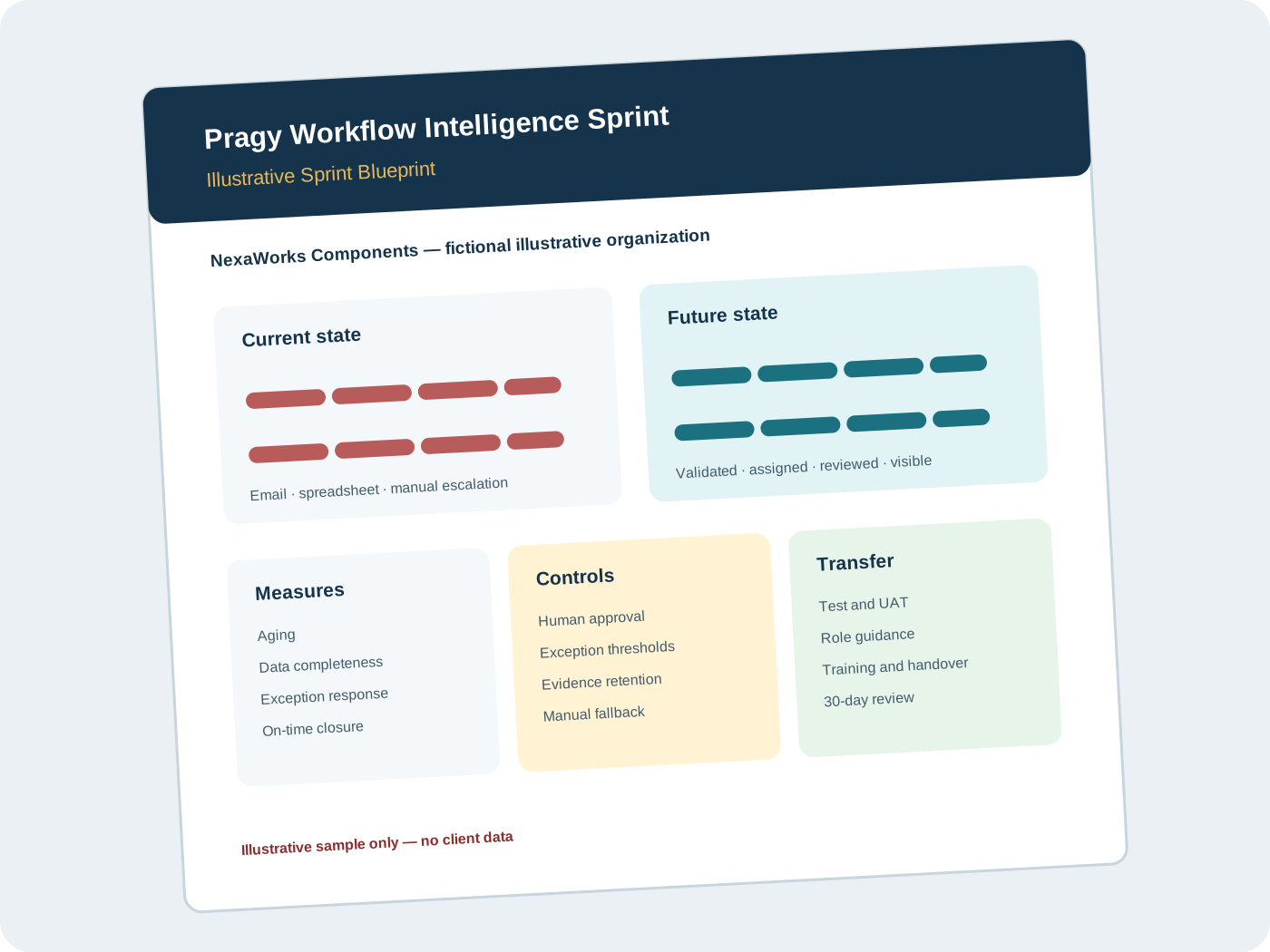
Explore a fictional supplier-delay exception workflow covering current state, measures, future state, controls, solution concept, testing, handover and the 30-day sustainment review.
The Quality & CAPA Intelligence Accelerator adds controlled taxonomy, recurrence-candidate review, CAPA aging and escalation, quality-data reconciliation, authorized quality decisions, validation boundaries and quality-management-review routines.
Pragy AI Fluency for Operations Leaders helps teams compare AI, analytics, automation and workflow redesign; identify human-review needs; and decide whether a candidate workflow is ready for assessment, governance or implementation.
The AI Agent Readiness & Governance Accelerator clarifies what one candidate agent may see, do, route, draft, refuse, escalate and monitor before the workflow pilot depends on it.
It is an implementation-focused engagement. The Design Sprint creates a build-ready workflow blueprint. The Pilot Build Sprint includes a bounded configured pilot within the approved technical and operating scope.
No. Organizations with a clearly defined, owned, and measurable workflow may begin with a sprint. The Opportunity Map is recommended when priorities, readiness, or the right pilot are not yet clear.
One workflow has a defined trigger, accountable owner, sequence of work, decisions, exceptions, and measurable outcome. Multi-workflow or enterprise-wide scope requires separate scoping.
Only when production deployment is explicitly included in the approved scope and the client has completed security, access, licensing, testing, and release approvals. A pilot may otherwise remain in a controlled test environment.
The tools depend on the workflow and approved environment. The sprint may use Microsoft 365, Power Platform, Power BI, SharePoint, Lists, forms, existing systems, standard connectors, or approved AI capabilities. No tool is applied by default.
Yes, when AI provides a practical and controlled benefit such as classification, summarization, retrieval, or decision support. AI is not added when standard process improvement, analytics, or conventional automation is the better solution.
Potentially, but regulated, validated, or quality-critical scope requires additional review and custom scoping. The standard sprint does not include legal advice, compliance certification, or computer-system validation.
The sprint normally requires a defined workflow, process owner, stakeholder availability, representative non-sensitive examples, business rules, available measures, high-level system information, and approved access arrangements.
No. Do not submit passwords, unrestricted credentials, personal data, patient data, regulated records, or confidential production information through the website form.
No. Software, platform, connector, hosting, or third-party license fees are not included unless explicitly stated in the approved scope.
The client may adopt the pilot, complete additional validation, scale the workflow, request a broader implementation, add a management-review system, or use internal teams to continue the roadmap.
No. Outcomes depend on workflow conditions, data, participation, technical constraints, adoption, controls, and client decisions. The sprint defines and measures the pilot but does not guarantee a specific financial or operating result.
Request the Pragy Workflow Intelligence Sprint to clarify the workflow, redesign the operating flow, configure an appropriate pilot, and transfer ownership with practical measures and controls.
info@pragyconsulting.com · +1 (514) 404-5435
Tell us about one workflow, the problem it creates, and the outcome your organization needs. Do not submit passwords, credentials, personal data, patient information, regulated records, or confidential production data through this form.
Use a short fit call to confirm the workflow boundary, owner, outcome, systems, and whether a Design Sprint, Pilot Build Sprint, or broader scope is appropriate. Book a Workflow Fit Call.
Information is used only to review and respond to this request. Do not submit credentials, confidential production information, regulated records, patient information, or personal data.