
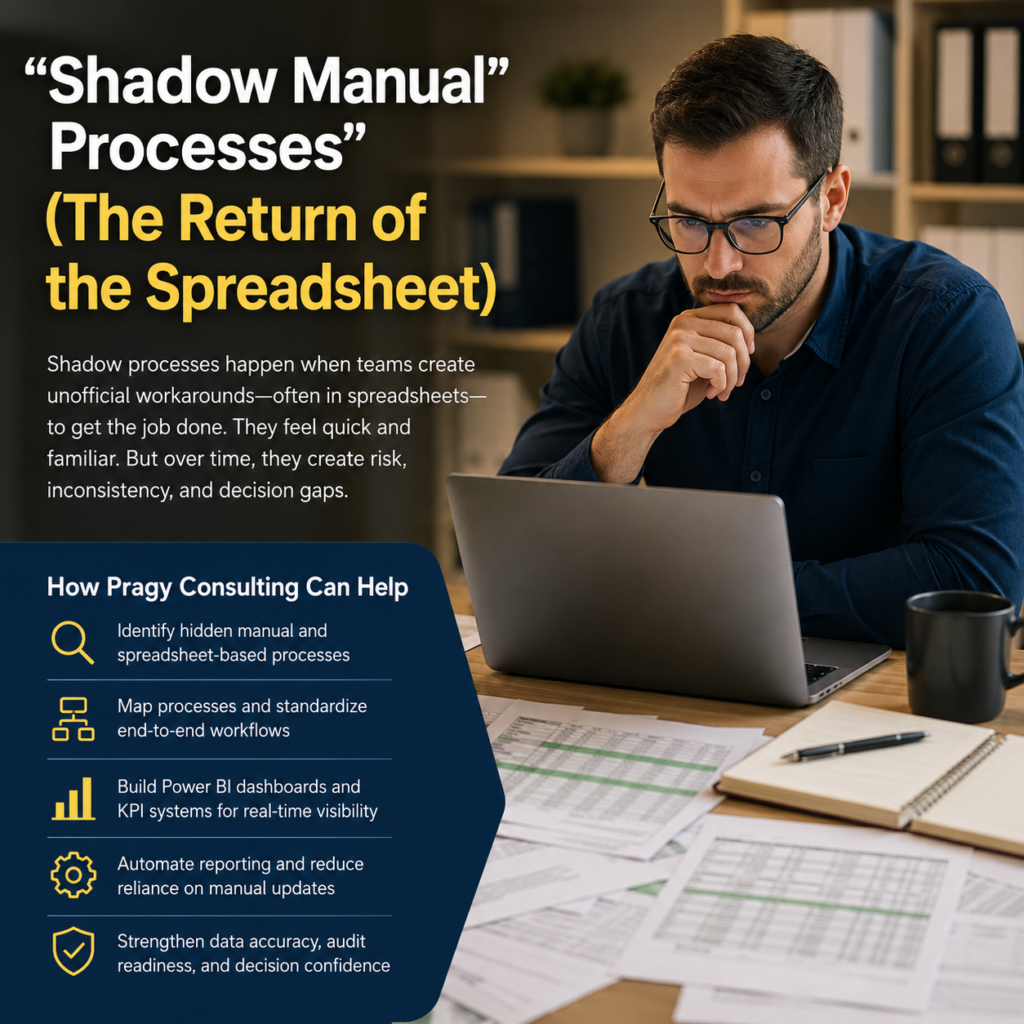
“Shadow manual” processes usually do not begin as a formal business decision. They start when a team needs to get something done quickly and the available system does not support the real workflow.
A planner builds a spreadsheet to track open orders. A quality team creates a manual deviation tracker. A finance analyst maintains a separate reconciliation file. A production supervisor emails a daily status sheet because the dashboard is not trusted. At first, these workarounds feel practical. They are flexible, familiar, and fast.
But over time, the spreadsheet becomes the process.
When this happens, the organization may still believe it has a controlled system, but the actual work is happening outside the system. That is where the risk begins.
What Are Shadow Manual Processes?
Shadow manual processes are unofficial workflows used by teams to complete, correct, supplement, or bypass formal systems. They often live in spreadsheets, email threads, shared folders, personal files, offline trackers, and manually updated PowerPoint reports.
These processes are common in operations-heavy environments such as manufacturing, pharma, quality, supply chain, finance, and small businesses. They usually appear when formal systems do not answer practical business questions quickly enough.
Examples include:
- A production team maintaining its own daily output tracker outside the ERP system.
- A quality team using a spreadsheet to monitor overdue CAPAs or deviations.
- A supply chain team manually combining demand, inventory, and purchase order data for S&OP meetings.
- A finance team copying data from multiple systems into a month-end reporting file.
- A leadership team relying on manually prepared KPI slides instead of a controlled dashboard.
The problem is not that spreadsheets are bad. Spreadsheets are useful tools for analysis, quick calculations, and temporary problem solving. The issue starts when spreadsheets become the permanent control mechanism for critical business decisions.
Why Spreadsheets Return After Systems Are Implemented
Many businesses invest in ERP systems, quality systems, CRM platforms, planning tools, and reporting software. Yet manual spreadsheets often return because the underlying process gaps remain unresolved.
Common reasons include:
- System reports are too slow or difficult to use. Teams need answers faster than the system provides them.
- Data is fragmented across departments. Operations, finance, quality, and supply chain may each hold part of the answer.
- Business rules are not clearly defined. Different teams calculate the same KPI in different ways.
- Dashboards do not reflect real working needs. Reports may show high-level numbers but miss the operational detail required for action.
- Processes were automated before they were standardized. Technology was added, but variation in the workflow remained.
When these issues are not addressed, people create their own practical solutions. The spreadsheet returns because it gives users control, even if that control comes with risk.
The Hidden Cost of Shadow Manual Processes
Shadow manual processes are often tolerated because they appear to keep work moving. However, they create hidden costs that become visible during audits, leadership reviews, customer escalations, month-end close, production delays, or performance improvement projects.
1. Version-Control Problems
When several people maintain copies of the same file, it becomes difficult to know which version is correct. A supply chain team may use one inventory number while finance uses another. A plant manager may review a production file that is already outdated. These differences lead to confusion and extra meetings just to reconcile the truth.
2. Manual Rework
Many teams spend hours copying, cleaning, formatting, checking, and rechecking data. This work may be necessary in the short term, but it does not add long-term value. It also pulls skilled employees away from analysis, problem solving, and decision support.
3. KPI Inconsistency
Manual reporting often creates inconsistent KPI definitions. For example, one department may calculate on-time delivery based on requested date, while another uses committed date. One site may define downtime differently from another. Without standard definitions, leadership discussions become debates about the numbers instead of decisions about performance.
4. Audit and Compliance Risk
In regulated or quality-sensitive environments, uncontrolled spreadsheets can create traceability concerns. If a spreadsheet supports decisions related to quality, complaints, deviations, production release, or supplier performance, the business needs confidence that the data is accurate, controlled, and reviewed appropriately.
5. Slow Decision-Making
When reporting depends on manual preparation, leaders often receive information after the issue has already moved on. A late order, capacity constraint, quality backlog, or material shortage may not be visible early enough for preventive action.
Where Shadow Processes Commonly Appear
Shadow manual processes tend to appear around cross-functional handoffs. These are the points where one system, team, or department cannot fully answer the business question alone.
Typical areas include:
- S&OP and planning: manual demand, supply, inventory, and capacity files.
- Manufacturing operations: daily production trackers, downtime logs, scrap reports, and shift handover files.
- Quality management: deviation, CAPA, complaint, audit action, and training trackers.
- Finance reporting: manual reconciliations, cost variance files, and month-end reporting packs.
- Management reporting: manually refreshed KPI decks and leadership scorecards.
These areas usually need more than a dashboard. They need process clarity, ownership, standard definitions, and reliable data flow.
How to Reduce Spreadsheet Dependency Without Disrupting the Business
The practical answer is not to ban spreadsheets. That rarely works. Instead, businesses should identify which spreadsheets are temporary tools and which have become hidden operating systems.
A structured approach can help:
1. Identify Critical Manual Files
Start by listing the spreadsheets and trackers used for recurring decisions. Focus on files that affect customer commitments, production plans, quality actions, financial results, inventory decisions, or leadership reporting.
2. Map the Real Process
Document how work actually happens, not how the formal procedure says it should happen. Identify who provides data, who updates the file, who reviews it, how often it changes, and what decisions depend on it.
3. Standardize KPI Definitions
Agree on clear definitions for key measures such as on-time delivery, schedule adherence, backlog, yield, downtime, forecast accuracy, inventory turns, overdue actions, and cost variance. This reduces debate and improves trust in reporting.
4. Build Controlled Dashboards
Power BI dashboards can replace many recurring manual reports when the data model is designed correctly. A useful dashboard should connect data from relevant sources, apply consistent business rules, and show information at the right level for decision-making.
5. Keep Exceptions Visible
Not every process can be fully automated immediately. However, exceptions should be visible. A dashboard can highlight missing data, overdue updates, unresolved variances, or manual adjustments so teams can manage risk instead of hiding it.
How This Helps Business Leaders
For business leaders, shadow manual processes are not just an administrative issue. They affect speed, control, accountability, and confidence in decisions.
Reducing spreadsheet dependency helps leaders:
- See performance issues earlier.
- Improve trust in KPI reporting.
- Reduce time spent reconciling different versions of the truth.
- Strengthen audit readiness and process control.
- Free teams from repetitive manual reporting work.
- Improve cross-functional alignment across operations, finance, quality, and supply chain.
The goal is not to remove every spreadsheet. The goal is to make sure critical decisions are supported by reliable, standardized, and visible information.
How Pragy Consulting Can Help
Pragy Business Process Consulting Services helps organizations identify, simplify, and improve reporting and operational processes that have become too dependent on manual spreadsheets.
Support can include:
- Reviewing current manual trackers, spreadsheet reports, and shadow processes.
- Mapping end-to-end workflows across operations, quality, supply chain, finance, and leadership reporting.
- Standardizing KPI definitions and reporting logic.
- Designing Power BI dashboards for operational visibility and management reporting.
- Building practical KPI systems that support daily, weekly, and monthly decision-making.
- Applying Lean Six Sigma and operational excellence methods to reduce rework and process variation.
For pharma, manufacturing, operations, finance, and small business teams, this work can create a clearer connection between process performance and business decisions.
Final Thought
Shadow manual processes usually exist because employees are trying to solve real business problems. The spreadsheet is often a symptom, not the root cause.
When leaders understand why these workarounds exist, they can improve the process, standardize the data, and build reporting systems that teams actually trust. With the right combination of process improvement, KPI design, and Power BI dashboard development, businesses can reduce manual effort and make decisions with greater confidence.
If your organization relies on recurring spreadsheets for critical reporting, KPI reviews, S&OP meetings, quality tracking, or operational decisions, Pragy Business Process Consulting Services can help assess the current process and design a practical path toward better visibility and control.