
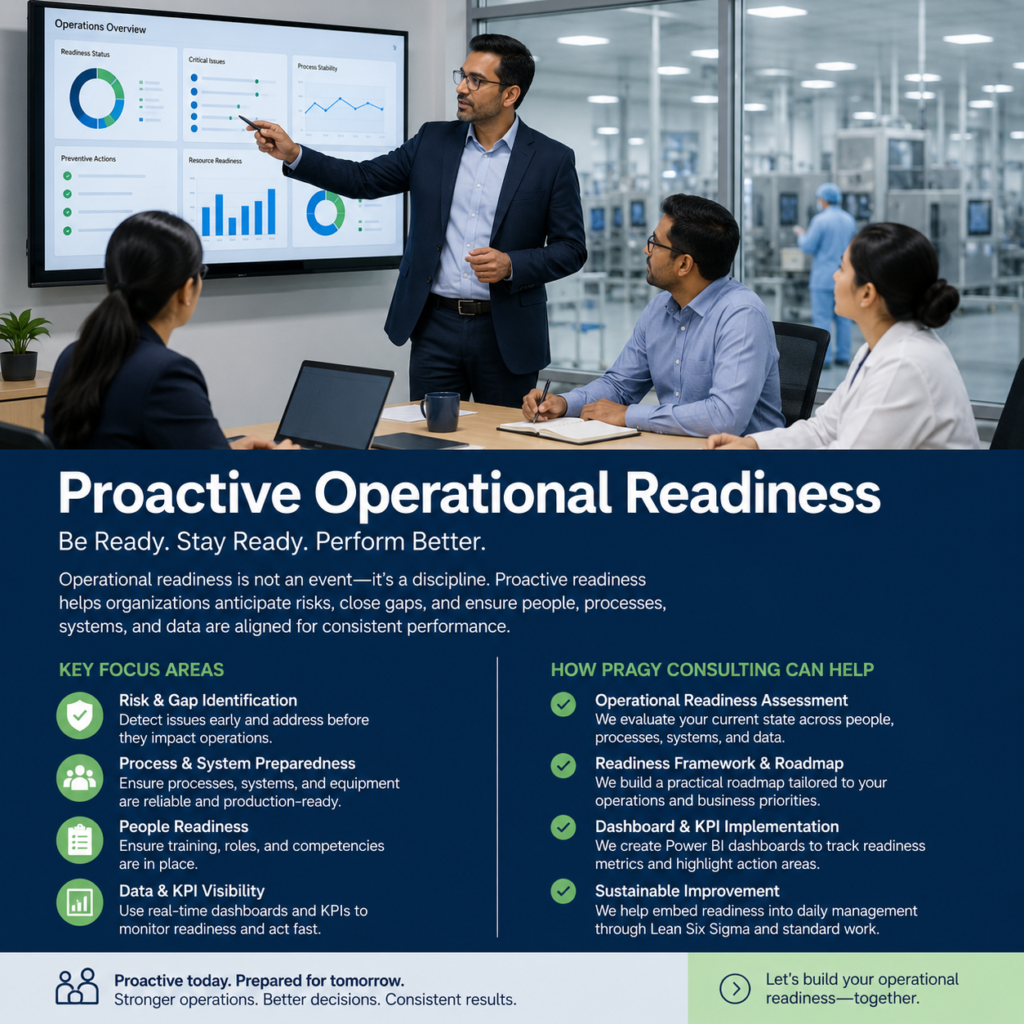
Proactive operational readiness is the discipline of confirming that people, processes, systems, data, materials, and governance are prepared before execution pressure begins. It applies to product launches, process transfers, new reporting systems, S&OP routines, production changes, quality improvements, finance close processes, and management reporting.
Many organizations treat readiness as a final checklist. The project team reaches the planned go-live date, asks whether training is complete, confirms whether dashboards are available, and then discovers that key gaps are still unresolved. The process may technically start, but leaders spend the first weeks reacting to missing data, unclear ownership, unstable workflows, and delayed decisions.
A proactive approach changes the conversation. Instead of asking, “Are we ready?” at the end, leaders ask, “What evidence shows we are becoming ready?” throughout the work. That shift supports better execution, clearer accountability, and stronger operational control.
What Proactive Operational Readiness Means
Operational readiness is not limited to equipment, systems, or training. It is a practical management system that connects strategy with execution. A ready operation has defined processes, capable people, reliable data, visible KPIs, clear escalation routes, and agreed decision-making routines.
Proactive operational readiness usually includes:
- Clear readiness criteria for each function or workstream
- Defined process ownership and decision rights
- Documented standard work, SOPs, or operating procedures
- Validated data sources and agreed KPI definitions
- Training linked to actual job roles and responsibilities
- Open issue tracking with owners, due dates, and escalation rules
- Leadership review cadence supported by dashboards and action logs
The goal is not to create more administration. The goal is to make readiness visible early enough for leaders to act before delays, quality risks, reporting gaps, or customer service issues appear.
Why Readiness Gaps Often Appear Late
Readiness gaps usually do not appear suddenly. They build quietly when functions work in silos, assumptions are not tested, and status reporting focuses on task completion instead of operational capability.
For example, a manufacturing team may report that equipment preparation is complete, but maintenance spare parts are not aligned, operator training is incomplete, or the production dashboard does not reflect the right constraints. A finance team may launch a new reporting process, but data definitions differ across departments. A supply chain team may prepare an S&OP review, but demand, capacity, and inventory views are not connected in one consistent reporting model.
These issues are manageable when identified early. They become disruptive when discovered during launch, month-end close, batch execution, customer delivery, or leadership review.
Using KPIs to Measure Readiness
A proactive readiness model should include a small number of practical KPIs. The purpose is to show whether the organization is genuinely prepared, not simply whether project tasks are marked complete.
Useful readiness KPIs may include:
- Percentage of critical actions closed by due date
- Open high-risk issues by function or process area
- Training completion by role, not just by department
- SOP or standard work completion status
- Data quality checks completed for key reports
- System access readiness for required users
- Material, capacity, or resource readiness status
- Escalated decisions awaiting leadership approval
These indicators help leaders move from opinion-based status updates to evidence-based readiness reviews. A red or amber status should not be seen as failure. It should be treated as early visibility that allows the team to respond before execution is affected.
How Power BI Supports Operational Readiness
Power BI can make operational readiness easier to manage by bringing actions, risks, KPIs, and status indicators into one view. Instead of relying on separate spreadsheets, email updates, and meeting notes, leaders can use a structured readiness dashboard to monitor progress and focus discussions on the areas that need attention.
A practical operational readiness dashboard may include:
- Overall readiness status by workstream
- Open actions by owner, due date, and priority
- Risk heat maps for process, people, data, systems, and supply
- Trend views showing whether readiness is improving or stalled
- Drill-through pages for manufacturing, quality, supply chain, finance, or operations
- Decision logs showing items requiring leadership input
For pharma operations, this type of dashboard can support line readiness, batch execution preparation, quality documentation, training visibility, and process transfer reviews. For manufacturing, it can support new product introduction, production ramp-up, maintenance readiness, inventory planning, and daily management. For finance and management reporting, it can support month-end readiness, KPI reporting routines, and data governance.
Connecting Readiness with Lean Six Sigma
Lean Six Sigma tools can strengthen operational readiness by helping teams identify failure points before they affect performance. Tools such as process mapping, FMEA, root cause analysis, control plans, and standard work are practical ways to test whether a process is ready for consistent execution.
For example, a readiness review for a new production process should not only ask whether the process map exists. It should ask whether handoffs are clear, whether failure modes have been reviewed, whether controls are in place, and whether teams know how to escalate abnormal conditions.
This approach turns readiness from a document review into an operational risk management practice.
How This Helps Business Leaders
Business leaders need confidence that execution risks are visible and being managed. Proactive operational readiness provides that confidence by creating a clear link between plans, actions, risks, KPIs, and decisions.
It helps leaders:
- See readiness gaps before they become operational disruptions
- Hold teams accountable using clear ownership and due dates
- Prioritize support where risks are highest
- Improve communication across operations, quality, supply chain, finance, and leadership teams
- Make launch, reporting, and process changes more controlled
- Build stronger daily, weekly, and monthly management routines
The value is practical. Leaders spend less time chasing disconnected updates and more time removing barriers, making decisions, and supporting execution.
Common Signs Your Readiness Process Needs Improvement
An organization may need a stronger readiness model when status meetings are long but decisions are unclear, dashboards show activity but not risk, teams disagree on KPI definitions, or go-live decisions depend heavily on verbal updates.
Other warning signs include repeated last-minute escalations, incomplete training visibility, unclear process ownership, unstable reporting after launch, and action logs that are not connected to leadership review. These issues are common, but they can be reduced with better structure and visibility.
How Pragy Consulting Can Help
Pragy Business Process Consulting Services helps organizations build practical operational readiness systems that connect process improvement, KPI reporting, Power BI dashboards, and operational excellence.
Support can include:
- Operational readiness assessment across people, process, systems, data, and governance
- Readiness framework design for launches, reporting routines, S&OP processes, or operational changes
- Power BI dashboard development for readiness tracking and leadership reviews
- KPI definition, data model design, and reporting governance
- Lean Six Sigma support for process mapping, issue analysis, and control planning
- Action tracking, escalation structure, and management review cadence design
The focus is to make readiness visible, measurable, and useful for decision-making. Whether the need is in pharma operations, manufacturing analytics, quality, supply chain, finance, or small business management reporting, a structured readiness approach can help teams execute with better control.
Final Thought
Proactive operational readiness is not about adding another layer of reporting. It is about helping leaders and teams see whether the business is truly prepared to execute. When readiness is measured through clear KPIs, supported by Power BI dashboards, and strengthened through process improvement methods, organizations can identify gaps earlier and manage change with greater discipline.
Pragy Business Process Consulting Services can support your team in designing practical readiness dashboards, KPI systems, and operational improvement routines that fit your business environment.