
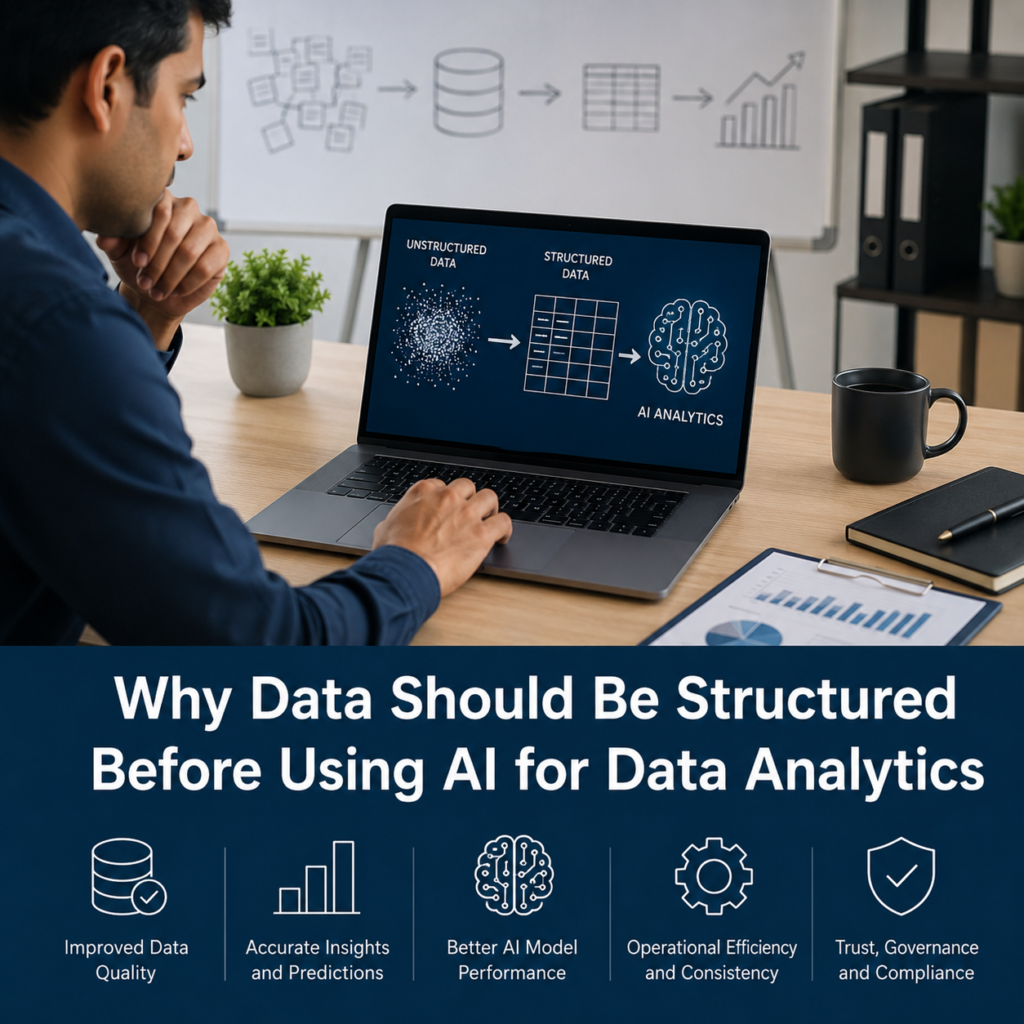
AI can help businesses analyze large volumes of data, identify patterns, summarize information, and support faster decision-making. But AI does not automatically fix poor data. If the data is scattered, inconsistent, incomplete, or poorly defined, the output from AI analytics can be misleading.
Before using AI for data analytics, businesses need a strong data foundation. That starts with structured data.
Structured data is not only a technical requirement. It is an operational discipline. For pharma, manufacturing, supply chain, quality, finance, and small business teams, structured data makes reporting more reliable, dashboards easier to maintain, and AI outputs easier to trust.
What Does Structured Data Mean?
Structured data is information organized in a consistent format with defined fields, standard naming, clear relationships, and agreed business rules. It can be searched, filtered, validated, analyzed, and connected across systems.
Examples of structured data include:
- Production records with standard fields for machine, product, shift, batch, downtime reason, and output quantity
- Quality records with consistent defect categories, inspection results, lot numbers, and disposition status
- Inventory data with item codes, locations, units of measure, suppliers, and stock status
- Sales and demand data mapped to customers, products, regions, time periods, and forecast versions
- Finance data with consistent cost centers, account codes, reporting periods, and expense categories
When data is structured properly, it becomes easier to connect operational activity with business performance. This is important for Power BI dashboards, KPI reporting, S&OP reviews, Lean Six Sigma analysis, and AI-based analytics.
Why AI Needs Structured Data
AI models work from the information they receive. If the source data is clean, complete, and logically organized, AI has a better chance of producing useful analysis. If the source data is messy, AI may generate outputs that appear confident but are not reliable.
For example, a manufacturing team may ask an AI tool to identify the main causes of production delays. If downtime reasons are entered differently by each shift, the AI may treat similar issues as separate categories. “Material delay,” “raw material late,” “RM not available,” and “supplier delay” may all refer to the same operational problem, but poor structure makes the analysis fragmented.
The same issue appears in pharma operations and quality systems. If batch records, deviation categories, inspection outcomes, or release statuses are not standardized, AI analytics may struggle to identify meaningful trends. In regulated environments, this can also create additional review and validation concerns.
What Happens When Data Is Not Structured?
Unstructured or poorly structured data creates several practical problems before AI analytics even begins.
1. Inconsistent Results
Different naming conventions, missing fields, duplicate records, and unclear definitions can lead to inconsistent AI outputs. One report may show a trend, while another report shows a different conclusion because the data was grouped differently.
2. More Manual Cleaning
Teams often spend significant time preparing data before analysis. They rename columns, remove duplicates, correct spelling, fill missing values, and reconcile conflicting records. This slows down analytics and reduces confidence in the final output.
3. Poor KPI Visibility
KPIs depend on clear definitions. If “on-time delivery,” “production efficiency,” “quality defect,” or “forecast accuracy” means different things to different teams, AI analytics cannot solve the problem. The business first needs one agreed version of each KPI.
4. Weak Dashboard Performance
Power BI dashboards and other business intelligence tools perform better when data models are designed properly. Poorly structured data can make dashboards slower, harder to update, and more difficult to troubleshoot.
5. Lower Trust in AI Output
Business leaders will not use AI insights if they do not trust the data behind them. When users see errors, missing context, or conflicting numbers, they quickly return to manual spreadsheets and individual judgment.
Structured Data Supports Better Business Questions
AI analytics is most useful when the business question is clear and the data is prepared to answer it. Structured data helps leaders ask better questions such as:
- Which products are driving the highest number of quality defects?
- Which production lines experience the most downtime by reason code?
- Which customers or regions are creating the largest forecast variances?
- Which suppliers are linked to recurring material shortages?
- Which process steps create delays in order fulfillment or batch release?
These questions require data that is connected across functions. Production, quality, inventory, finance, and supply chain data must share common identifiers, time periods, and definitions. Without that structure, AI may only provide surface-level summaries instead of actionable insight.
What Should Be Structured Before Using AI?
Businesses do not need perfect data before starting AI analytics, but they do need a practical minimum standard. The following areas should be reviewed first.
Data Definitions
Each important field should have a clear meaning. For example, a team should define exactly what counts as downtime, rework, scrap, forecast error, delayed order, open deviation, or overdue action.
Master Data
Product codes, customer names, supplier names, machine IDs, material numbers, and cost centers should be consistent across systems. Master data issues are one of the most common reasons dashboards and analytics become unreliable.
Data Relationships
AI and BI tools need to understand how data tables relate to each other. A production table may connect to a product master, quality table, maintenance log, inventory record, and finance table. These relationships should be designed intentionally.
Data Quality Rules
Basic validation rules help prevent poor data from entering the system. These may include required fields, approved dropdown values, valid date ranges, duplicate checks, and standard units of measure.
KPI Logic
Metrics should be calculated consistently. If a Power BI dashboard calculates production efficiency one way and a spreadsheet calculates it another way, AI analytics will only add more confusion.
Example: AI Analytics in Manufacturing
Consider a manufacturer that wants to use AI to understand why output is below plan. The business has data from production logs, maintenance records, quality inspections, and inventory transactions. However, each department uses different formats and naming conventions.
Before applying AI, the company should structure the data around common fields such as product, line, shift, date, batch, downtime reason, quality result, and material availability. Once this structure is in place, AI analytics can help identify relationships between downtime, material shortages, quality holds, and production losses.
The result is not just better AI. The business also gains cleaner Power BI dashboards, more reliable KPI reviews, and stronger operational discussions.
Example: AI Analytics in Pharma Operations
In pharma operations, structured data is especially important because quality, traceability, and documentation matter. A team may want to use AI to analyze deviations, batch release delays, or recurring inspection observations.
If deviation categories are inconsistent, root cause fields are incomplete, and closure timelines are not captured properly, AI cannot provide dependable insight. Structuring this information allows teams to review patterns by product, process step, site, department, investigation type, and corrective action status.
This supports better management reporting, stronger operational reviews, and more focused process improvement work.
How This Helps Business Leaders
Structured data helps business leaders move from scattered reports to dependable decision support. It improves the quality of AI analytics, but it also strengthens day-to-day management.
For leaders, the benefits include:
- More reliable decisions: Reports and AI outputs are based on consistent definitions and cleaner data.
- Faster reporting: Teams spend less time cleaning spreadsheets and more time reviewing performance.
- Better operational visibility: Dashboards can show trends across departments, sites, products, and time periods.
- Stronger KPI governance: Metrics are easier to explain, validate, and use in performance reviews.
- Improved process improvement: Lean Six Sigma and operational excellence projects can focus on verified problem areas.
- Greater confidence in AI: Users are more likely to trust AI analytics when the underlying data is well managed.
Structured data also makes it easier to scale analytics. A business can start with Power BI dashboards, then gradually add AI-supported analysis, forecasting, anomaly detection, or automated reporting where appropriate.
AI Should Build on Business Intelligence, Not Replace It
Many businesses are interested in AI before they have stable reporting, clean master data, or agreed KPI definitions. This creates risk. AI should not be treated as a shortcut around business intelligence fundamentals.
A better approach is to build the foundation first:
- Clarify the business questions
- Define the KPIs
- Clean and standardize the source data
- Build a structured data model
- Create reliable dashboards
- Use AI analytics to explore patterns, risks, and opportunities
This approach makes AI more practical and less speculative. It also allows managers to compare AI outputs against known operational measures.
How Pragy Consulting Can Help
Pragy Business Process Consulting Services helps organizations prepare their data, dashboards, and KPI systems for better analytics and decision-making.
Our support can include:
- Reviewing current reporting processes and data quality issues
- Structuring operational, quality, finance, supply chain, or production data for analytics
- Designing Power BI data models and dashboards
- Standardizing KPI definitions and reporting logic
- Supporting Lean Six Sigma and process improvement analysis
- Creating management reporting views for operations, S&OP, quality, and business performance reviews
Before using AI for data analytics, businesses need to know whether their data is ready. A structured foundation reduces confusion, improves reporting, and helps AI produce insights that leaders can actually use.
If your organization is planning to use AI, improve Power BI dashboards, or strengthen KPI reporting, Pragy Business Process Consulting Services can help you build the right data foundation first.