
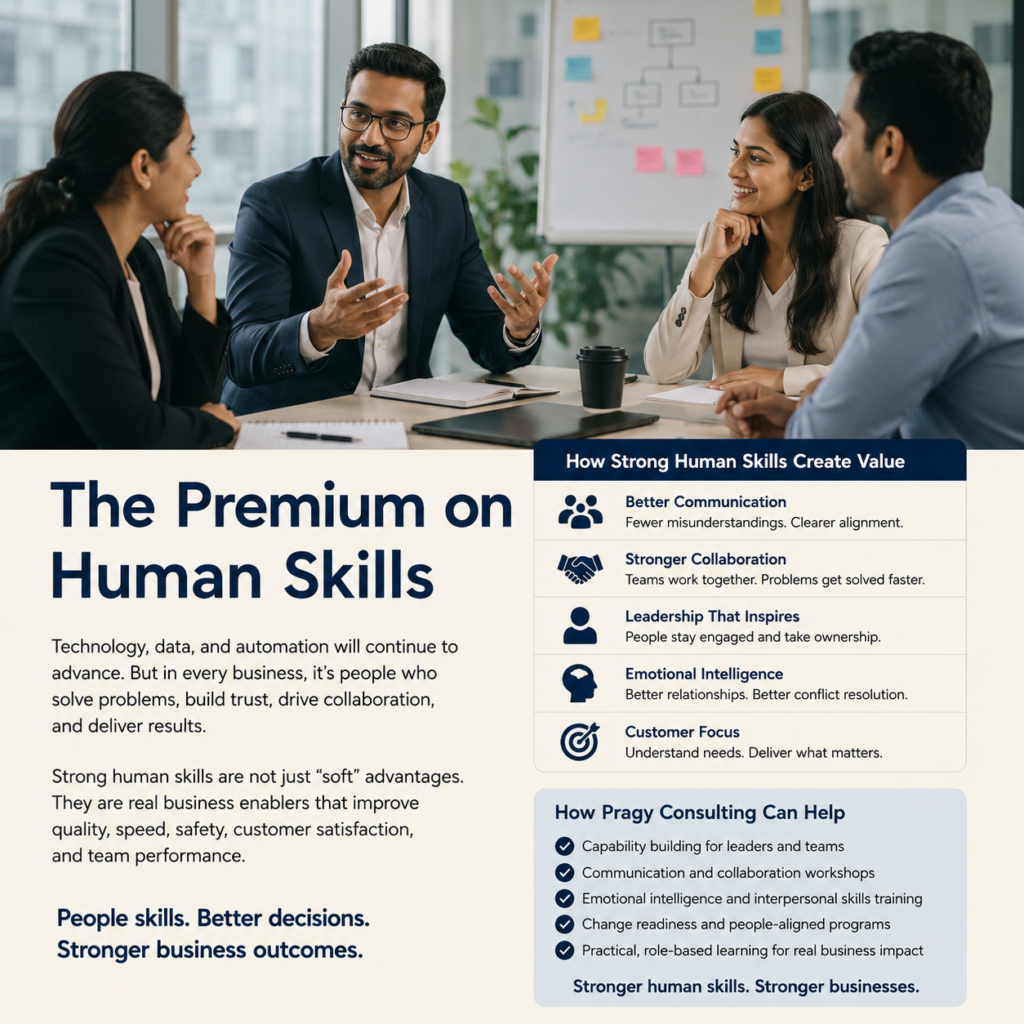
Technology, automation, artificial intelligence, and business intelligence tools continue to improve how organizations collect, process, and report information. Yet one point remains clear in daily operations: tools do not make decisions by themselves. People interpret data, solve problems, communicate priorities, manage trade-offs, and drive execution.
This is where the premium on human skills becomes important.
Human skills are often described as “soft skills,” but that label understates their business value. In manufacturing, pharma operations, quality, supply chain, finance, and small business management, these skills directly influence performance. A team may have a strong Power BI dashboard, a clear KPI structure, and well-documented processes, but weak communication or poor accountability can still lead to missed targets, rework, delays, and frustration.
The strongest organizations do not choose between technical capability and human capability. They build both.
What Are Human Skills in a Business Context?
Human skills are the practical interpersonal and decision-making capabilities that help people work effectively with others. They include communication, listening, collaboration, problem solving, critical thinking, adaptability, emotional intelligence, ownership, and leadership.
In an operational setting, these skills show up in simple but important ways:
- How a supervisor communicates a production issue to the next shift
- How a quality team discusses deviations without creating blame
- How finance explains margin pressure to operations leaders
- How supply chain teams align demand, capacity, and inventory risks
- How managers use KPI data to support decisions instead of defending past actions
These are not abstract behaviours. They affect cycle time, service levels, productivity, customer experience, compliance discipline, and employee engagement.
Why Human Skills Command a Premium
Many organizations invest heavily in systems, reporting tools, automation, and analytics. These investments are necessary, but they do not automatically create better performance. The value comes when people use information well.
A dashboard can show that on-time delivery is declining. It cannot, by itself, resolve unclear priorities between sales, planning, production, and logistics. A process map can show where handoffs occur. It cannot, by itself, build trust between teams that have been working in silos. A KPI report can show rising defects. It cannot, by itself, create a disciplined problem-solving conversation.
This is why human skills carry a premium. They turn information into alignment, alignment into decisions, and decisions into action.
The Connection Between Human Skills and Data-Driven Decisions
Business intelligence tools such as Power BI can provide useful visibility into performance. Leaders can see trends, exceptions, bottlenecks, and risks more clearly. However, better visibility does not guarantee better decisions.
Teams still need to ask the right questions:
- What is the data really telling us?
- Is this a one-time issue or a recurring pattern?
- Who needs to be involved in the decision?
- What action will we take, by when, and who owns it?
- How will we know whether the action worked?
These questions require critical thinking, communication, ownership, and discipline. Without those skills, dashboards can become passive reporting tools instead of active management systems.
For example, a manufacturing dashboard may show repeated downtime on a specific line. A technically capable team may identify the downtime trend, but a team with strong human skills will go further. They will involve maintenance, production, quality, and planning; discuss the issue without blame; validate root causes; agree on countermeasures; and track whether performance improves.
Human Skills in Pharma and Manufacturing Operations
In pharma and manufacturing environments, technical accuracy and process discipline are essential. However, human skills are also critical because work is highly cross-functional.
In pharma operations, a batch delay may involve production, quality assurance, quality control, supply chain, engineering, and regulatory considerations. If teams do not communicate clearly, small issues can become larger delays. If accountability is unclear, investigations may move slowly. If leaders do not create a problem-solving culture, teams may focus more on explaining performance gaps than resolving them.
In manufacturing, similar challenges appear around downtime, scrap, changeovers, labour planning, inventory shortages, and customer delivery commitments. The numbers may identify where the issue is, but people must work together to correct it.
Strong human skills help teams:
- Escalate issues earlier
- Separate facts from assumptions
- Reduce defensiveness in performance reviews
- Improve shift-to-shift and department-to-department handoffs
- Build ownership around corrective actions
Why Human Skills Matter in KPI Reviews
KPI reviews are one of the clearest places where human skills affect business outcomes. The same dashboard can create very different results depending on how leaders use it.
A weak KPI review often focuses on explaining why targets were missed. The discussion becomes reactive, defensive, or too detailed. Actions are unclear, owners are not confirmed, and the same issues return the following week.
A stronger KPI review is different. Leaders focus on the few metrics that matter most, discuss exceptions, identify root causes, agree on actions, and follow up. The tone is practical and fact-based. People are expected to be honest about problems and disciplined about commitments.
This requires more than a good report layout. It requires facilitation, listening, prioritization, decision making, and accountability.
Human Skills and Lean Six Sigma
Lean Six Sigma is often associated with tools such as process maps, root cause analysis, Pareto charts, control plans, and DMAIC projects. These tools are valuable, but project success also depends on human skills.
A process improvement project may fail if stakeholders are not engaged, frontline knowledge is ignored, or changes are not communicated well. A technically correct solution may still struggle if people do not understand the reason for change or if managers do not reinforce the new process.
Human skills support Lean Six Sigma by helping teams:
- Define the real business problem clearly
- Listen to employees who work inside the process every day
- Facilitate practical root cause discussions
- Manage resistance to change
- Sustain improvements after implementation
Process improvement is not only about designing a better process. It is also about helping people adopt and maintain that process.
How This Helps Business Leaders
For business leaders, the premium on human skills shows up in better execution. When teams communicate clearly, understand priorities, and take ownership, leaders spend less time chasing updates and more time making informed decisions.
Strong human skills help leaders improve:
- Decision quality: Teams are better able to interpret data, discuss trade-offs, and act on facts.
- Execution discipline: Actions have clear owners, timelines, and follow-up.
- Cross-functional alignment: Operations, quality, supply chain, finance, and leadership work from a shared view of priorities.
- Problem solving: Teams move beyond symptoms and focus on root causes.
- Change adoption: Employees are more likely to support changes when communication is clear and practical.
This is especially important for small and mid-sized businesses where the same people often carry multiple responsibilities. Better dashboards and better processes are valuable, but they must be supported by strong communication, accountability, and leadership routines.
Building Human Skills Into Management Systems
Human skills should not be treated as a separate training topic that sits outside daily work. They should be built into the way teams manage performance.
Practical ways to do this include:
- Designing KPI reviews that encourage fact-based discussion
- Creating clear escalation routines for operational issues
- Using dashboards to guide decisions, not just report history
- Training managers to ask better problem-solving questions
- Clarifying ownership for actions and follow-up
- Improving meeting discipline so discussions lead to decisions
For example, a Power BI dashboard can be designed to highlight exceptions, trends, and action areas. But the management routine around that dashboard is just as important. Who reviews it? How often? What decisions are expected? What happens when a metric is off track? How are actions tracked?
These questions connect analytics with leadership behaviour.
How Pragy Consulting Can Help
Pragy Business Process Consulting Services helps organizations connect dashboards, KPI systems, process improvement, and operational excellence practices with the human routines needed to make them work.
Support may include:
- Power BI dashboard development for operational, financial, quality, and supply chain reporting
- KPI framework design aligned with business priorities
- Management reporting systems that improve visibility and accountability
- Lean Six Sigma and process improvement support
- Operational excellence consulting for pharma, manufacturing, and business teams
- Practical review routines that help leaders turn data into action
The goal is not to add more reports or meetings. The goal is to help leaders and teams use information more effectively, solve problems faster, and build stronger operating discipline.
Conclusion
The premium on human skills is real because business performance still depends on people. Technology can improve visibility. Dashboards can organize information. Process tools can identify waste and variation. But people must communicate, decide, collaborate, and follow through.
Organizations that combine strong analytics with strong human skills are better positioned to improve performance in a practical and sustainable way.
Pragy Business Process Consulting Services supports companies that want clearer dashboards, stronger KPI systems, better process discipline, and more effective operational decision-making. For organizations looking to improve how teams use data and act on performance priorities, Pragy Consulting can provide practical, business-focused support.